Black Coffee Linked To Longer Life, But Sugar And Cream May Undo Benefits – New Study Reveals
10/10/2026 / By Coco Somers

Black Coffee Linked to 14% Lower Death Risk in 46,000 Americans
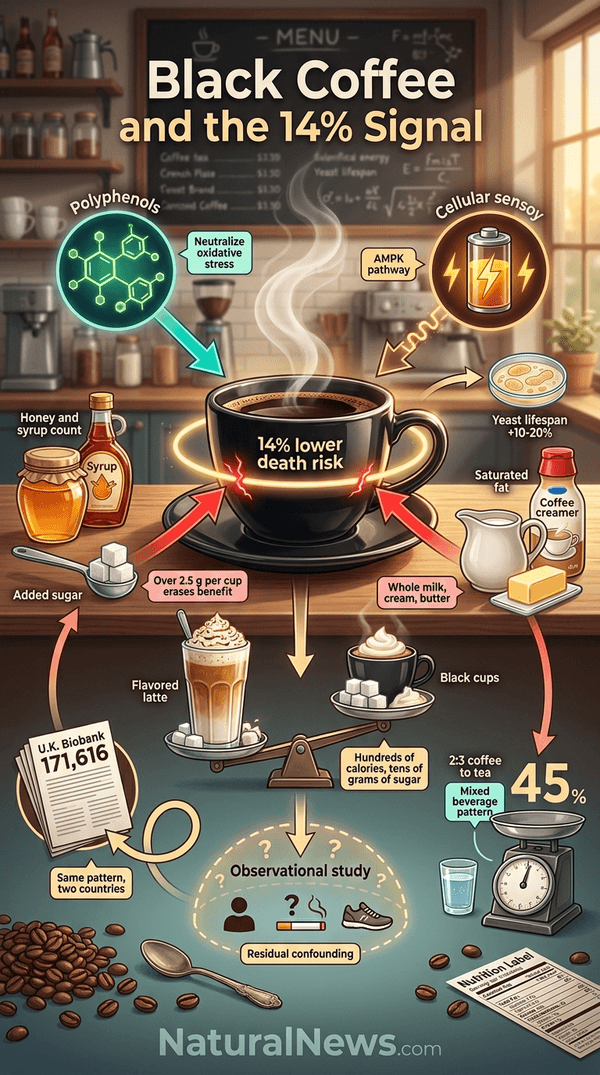
The association strengthened at higher intake. At two to three cups per day, Tufts University reported the link rose to 17% [1][2]. The apparent benefit did not hold, however, for coffee prepared with heavy amounts of added sugar and saturated fat. In the Tufts data, that combination showed no lower risk of death at all [3].
The findings add to an existing body of research on coffee and mortality. A comprehensive review of decades of research across hundreds of large-scale, multi-country studies associates moderate coffee consumption with longer life and a lower risk of mortality from chronic diseases [4]. Coffee is enjoyed by about 7 in 10 Americans each week, with 62% drinking it daily, according to Mercola.com [5].
How Researchers Defined Low and High Add-Ins
Low added sugar was defined as less than 2.5 grams per 8-ounce cup, roughly half a teaspoon. The thresholds were set at under 5% of the Daily Value for added sugar and for saturated fat, with the source of added sugar including granulated sugar, honey, and syrup [6].
Overall, the benefit faded once added sugar, saturated fat, or both exceeded about 5% of the daily value, the researchers reported. First author Bingjie Zhou of the Friedman School of Nutrition Science and Policy at Tufts University said the results align with federal dietary advice. “Our results align with the Dietary Guidelines for Americans, which recommend limiting added sugar and saturated fat,” Zhou said.
The design carries an inherent limit: the study was observational, so it can show association but not causation.
Coffee consumption has also been linked to lower risks of cardiovascular disease, digestive diseases, and Parkinson’s disease, according to an analysis of the Tufts findings [7]. Practically, a cup of black coffee, tea, or herbal tea contains only about two calories, offering what one physician-authored book on disease prevention describes as nutrition with scarce calories [8].
2022 U.K. Biobank Study Reported Similar Findings With Minimal Sugar
An earlier, larger observational study produced comparable results with slightly looser limits on sweetness. A 2022 analysis of 171,616 participants in the U.K. Biobank found that those who drank coffee with minimal added sugar had a lower risk of death than non-coffee drinkers, while those who added sugar did not see the same benefit.
The pattern offered some reassurance for people who cannot drink coffee black, and coverage of the U.K. study described the findings as offering some reassurance for people who cannot drink coffee black.
Separate research has examined how coffee fits alongside other beverages. A study of 182,770 adults found that drinking roughly two cups of coffee and three cups of tea daily, plus water, was linked to a 45% lower risk of death from all causes, with the 2:3 coffee-to-tea ratio associated with a 41% lower risk of cancer-related death [9].
Researchers Suggest Bioactive Compounds, Cite Observational Limits
The same summary notes the researchers suggested large amounts of sugar and saturated fat may work against those compounds. Coffee and tea are leading sources of antioxidant polyphenols, beneficial substances that have been linked to lower risks of heart failure, stroke, and nonalcoholic fatty liver disease, according to Mercola.com [10].
Mechanistic research offers a possible pathway. Caffeine activates the AMPK longevity pathway, stress-testing cells to boost repair and survival, and studies on yeast show caffeine extends lifespan by 10 to 20%, with implications for human healthspan; the report notes those benefits diminish with added sugar [11].
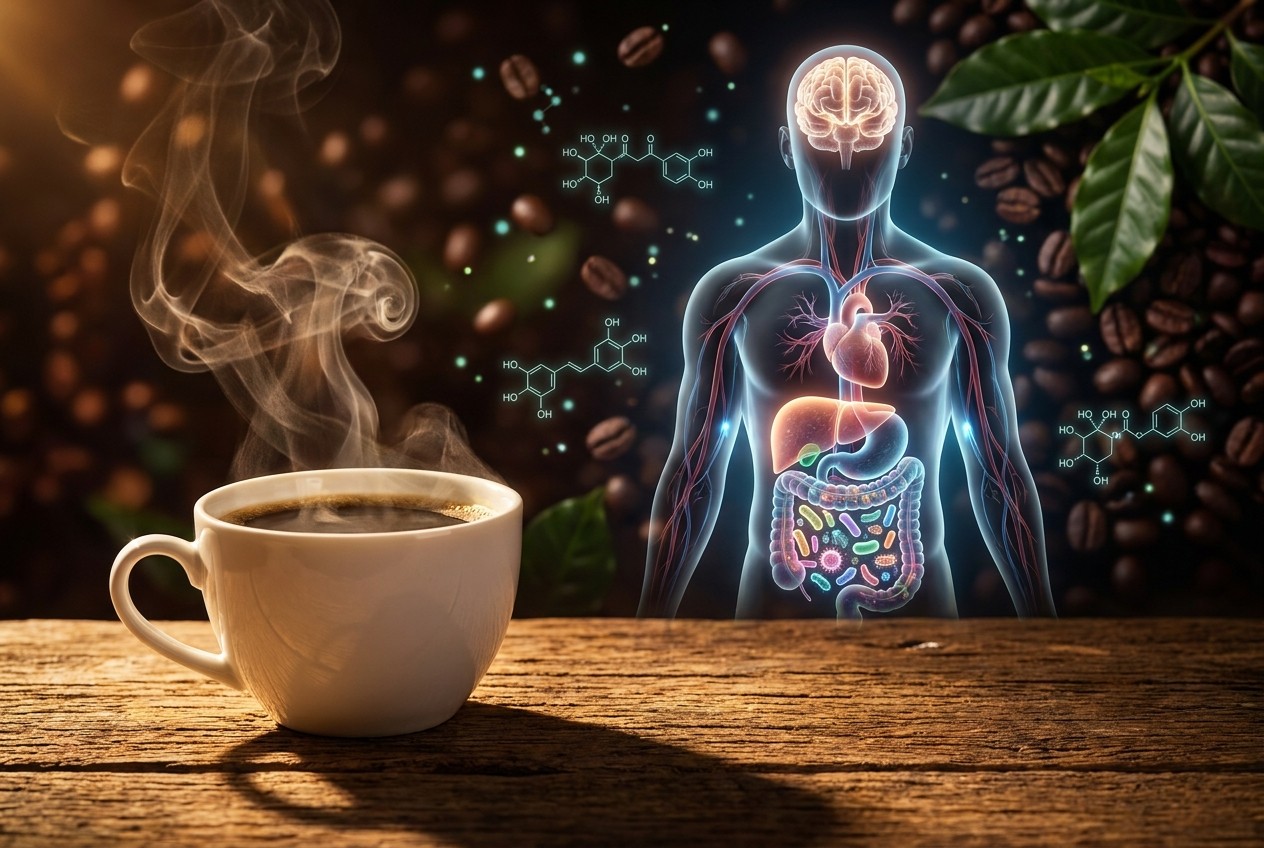
Researchers have also found an association between coffee consumption and a lower risk of frailty in older adults in a prospective cohort study of 12,583 adults in Singapore [12]. Another study examining both caffeinated and decaffeinated coffee found links to mood improvement and stress reduction via the gut-brain axis; researcher Dr. John Cryan, a principal investigator at APC Microbiome Ireland, said the findings suggest coffee’s benefits extend beyond caffeine [13].
None of this amounts to proof. Both the Tufts and U.K. studies were observational, meaning they can show associations but cannot establish that coffee itself caused the outcomes.
Takeaways for Coffee Consumption and Added Ingredients
For most coffee drinkers, the studies do not suggest giving up the habit. Integrative medicine specialist Betsy Greenleaf told mindbodygreen that black coffee contains more than 1,000 bioactive chemicals that can promote longevity, while emphasizing avoidance of added sugars and selection of high-quality, organic, contaminant-free products [14].
The variable that appears to matter most is what goes into the cup. The levels observed in the data are modest: half a teaspoon of sugar per cup or about one teaspoon per cup, not the volume delivered by typical flavored cafe drinks. Saturated fat and added sugar also appear on broad lists of dietary components to minimize, a position reflected in physician-authored guidance that places sugar, grain, corn, soy, and dairy among foods to limit [15]. Zhou said the results align with the Dietary Guidelines for Americans, which recommend limiting added sugar and saturated fat.
To make coffee itself more supportive of health, some nutrition sources recommend simple additions such as cinnamon, unsweetened cocoa powder, or protein powder, along with selecting quality beans and upgrading brewing methods [16]. The coffee may be doing its part; the research suggests the trick is not to undo it on the way to the lid.
References
- Studies Link Coffee Consumption to Health Benefits Including Longevity, Gut Health. https://www.naturalnews.com/2026-06-18-studies-link-coffee-consumption-to-longevity-gut-health.html
- Black coffee linked to longer life but sugary drinks cancel benefits study finds – NaturalNews.com, June 17, 2025
- Black Coffee Cuts Death Risk, But Sugar Erases Benefits. https://scienceblog.com/black-coffee-cuts-death-risk-but-sugar-erases-benefits/
- Research Review Links Moderate Coffee Consumption to Longevity Benefits – NaturalNews.com, April 22, 2026
- How Does Coffee Affect Your Metabolism – Mercola.com, April 22, 2022
- Hold the cream and sugar: black coffee linked to lower risk of death. https://www.eurekalert.org/news-releases/1087622
- Study links daily Black Coffee consumption to longevity but additives may diminish benefits – NaturalNews.com, May 20, 2026
- How Not to Die Discover the Foods Scientifically Proven to Prevent and Reverse Disease by Greger Michael MD Gene Stone
- The surprising drink combo that could add years to your life – NaturalNews.com, May 06, 2026
- Tea Drinkers Shown To Be More Healthy – Mercola.com, January 20, 2020
- Caffeine induced cellular stress response linked to slower aging A new pathway to healthspan – NaturalNews.com, July 16, 2025
- Daily Coffee or Tea Consumption Linked to Lower Frailty Risk in Older Adults, Study Finds. https://www.naturalnews.com/2026-07-27-daily-coffee-tea-consumption-linked-lower-frailty-risk.html
- Study: Both Caffeinated and Decaffeinated Coffee Linked to Mood Improvement and Stress Reduction via Gut-Brain Axis. https://www.naturalnews.com/2026-05-05-caffeinated-decaffeinated-coffee-linked-to-mood-improvement.html
- Experts Identify Five Healthiest Drinks Beyond Water, With Emphasis on Quality and Sourcing. https://www.naturalnews.com/2026-05-20-experts-identify-five-healthiest-drinks-beyond-water.html
- The paleo cardiologist the natural way to heart health by Wolfson Jack
- Report: Five Methods to Increase Health Benefits of Coffee Consumption. https://www.naturalnews.com/2026-07-21-five-methods-increase-health-benefits-coffee-consumption.html
Explainer Infographic
Submit a correction >>
Tagged Under:
antioxidants, black coffee, caffeine, coffee, diabetes, food cures, food is medicine, food science, functional foods, grocery, health science, longevity, natural cures, natural health, natural medicine, Naturopathy, nutrition, organics, phytonutrients, prevention, stress relief
This article may contain statements that reflect the opinion of the author
RECENT NEWS & ARTICLES